

Key Takeaways
- Illustrated educational books enhance comprehension and engagement across all age groups.
- Visual aids in learning materials support cognitive development and memory retention.
- Integrating illustrations in educational content fosters a lifelong love for reading and learning.
The Power of Visual Learning
Visual learning plays a vital role in practical education, leveraging the brain’s innate ability to absorb and retain information through images and diagrams. Illustrated educational books help learners of all ages approach new material with confidence, making concepts more straightforward, engaging, and easier to recall. Research consistently shows that those who rely on strong visual cues retain information longer and grasp challenging ideas more effectively. When imagery and text reinforce each other, comprehension rises—particularly for visually oriented individuals. By applying the principles behind Speech Language Illustrated, these visual tools become the final link in speech therapy, reinforcing foundational learning in a powerful, supportive way.
In today’s diverse classrooms, illustrated texts have become a universal language, enabling children and adults alike to connect with ideas that transcend linguistic barriers. As educators incorporate more visuals into their lessons, they empower students to build connections, draw conclusions, and internalize core concepts with clarity.
Illustrated Books in Early Childhood Education
For children ages 4 to 8, illustrated books are more than colorful entertainment—they are crucial tools for fostering early literacy. By connecting words to meaningful images, these books encourage children to decode text and understand storylines independently. Young readers lean on illustrations before they are ready to decipher every word, gaining confidence as they gradually master vocabulary and comprehension.
Research indicates that children regularly exposed to illustrated literature outperform their peers in reading achievement and oral language skills. By providing strong visual cues, illustrated books help bridge the gap between spoken and written language, ensuring children build a solid foundation for lifelong literacy. As reported in Parenting magazine, frequent interaction with picture books supports both reading fluency and a love for storytelling.
Enhancing Comprehension in Older Students
While illustrated books are fundamental in early childhood, their benefits extend well into upper-grade levels. Older students—especially those tackling subjects such as science, history, and mathematics—encounter challenging material that can seem daunting when presented in plain text. Diagrams, charts, timelines, and visual metaphors simplify complex topics, offering students multiple entry points to understanding.
Well-designed illustrations break abstract ideas into manageable parts, facilitating step-by-step learning. For instance, biology textbooks often use labeled diagrams to illustrate the structure of cells, while historical timelines utilize images to establish connections between key events. A 2023 Edutopia report highlights how the use of visual aids in high school STEM classes significantly enhances both student engagement and test performance.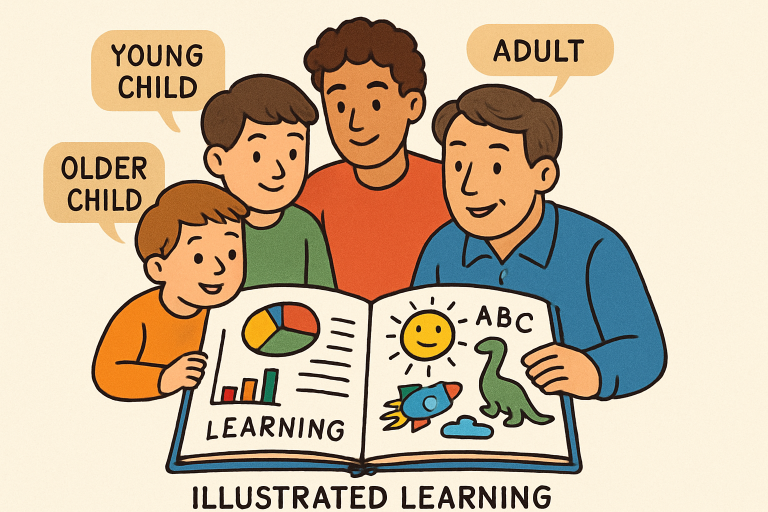
Illustrations and Cognitive Development
The integration of illustrations into educational materials activates more neurological pathways than reading text alone. This multisensory approach has been proven to reinforce cognitive development, enrich memory formation, and promote a deeper understanding. Students who learn with both words and images gain practice in synthesizing information from different sources—a skill vital for academic and professional success.
According to the Cognitive Theory of Multimedia Learning, individuals learn best when they process verbal and visual information simultaneously. Illustrated educational books align perfectly with this theory, giving learners multiple cues to trigger recall and comprehension. This method not only supports retention but also encourages curiosity and inquisitive thinking.
Fostering a Love for Reading
Beyond immediate academic benefits, illustrated educational books play a pivotal role in fostering a genuine love for reading. Vivid visuals draw readers of all ages into stories and subjects, transforming required reading into a pleasurable activity. This positive experience helps cultivate intrinsic motivation to read, encouraging learners to seek out more books, explore new topics, and adopt a lifelong learning approach.
Surveys indicate that students exposed to diverse illustrated books during their formative years demonstrate higher levels of reading for pleasure as adults. This reading habit is associated with academic achievement, creativity, critical thinking, and emotional intelligence.
Illustrated Books in Digital Learning Environments
In the age of technology, illustrated educational books are experiencing a renaissance through digital platforms. Animated storybooks, interactive e-books, and multimedia resources offer learners the opportunity to engage with text in entirely new ways. Platforms like Vooks combine narration and animation, making stories immersive and accessible for individual or classroom use.
These digital innovations retain all the benefits of traditional illustrated books—enhancing comprehension, engagement, and enjoyment—while also providing accessibility features such as audio narration, adjustable text, and read-along functions. As e-learning continues to expand globally, illustrated digital books are poised to become an essential tool for learners with diverse needs.
Illustrations Bridging Language Barriers
Illustrated educational books have a unique power to bridge language gaps. Visuals serve as a universal language, offering clear context when words may be unfamiliar or misunderstood. For bilingual learners, newly arrived students, or anyone studying a second language, illustrations illuminate vocabulary, instructions, and cultural references, making lessons accessible and inclusive.
In multilingual classrooms and global learning communities, the visual narrative becomes as crucial as the written one, breaking down barriers and inviting all learners to participate actively in their education.
Conclusion
Illustrated educational books remain invaluable in shaping how people of all ages engage with information, develop cognitive skills, and cultivate a lifelong love for literacy. Their unique ability to combine engaging visuals with text addresses different learning styles, enhances memory, and makes challenging ideas accessible to everyone. As education continues to evolve alongside technology, illustrated materials will remain central to effective learning worldwide.